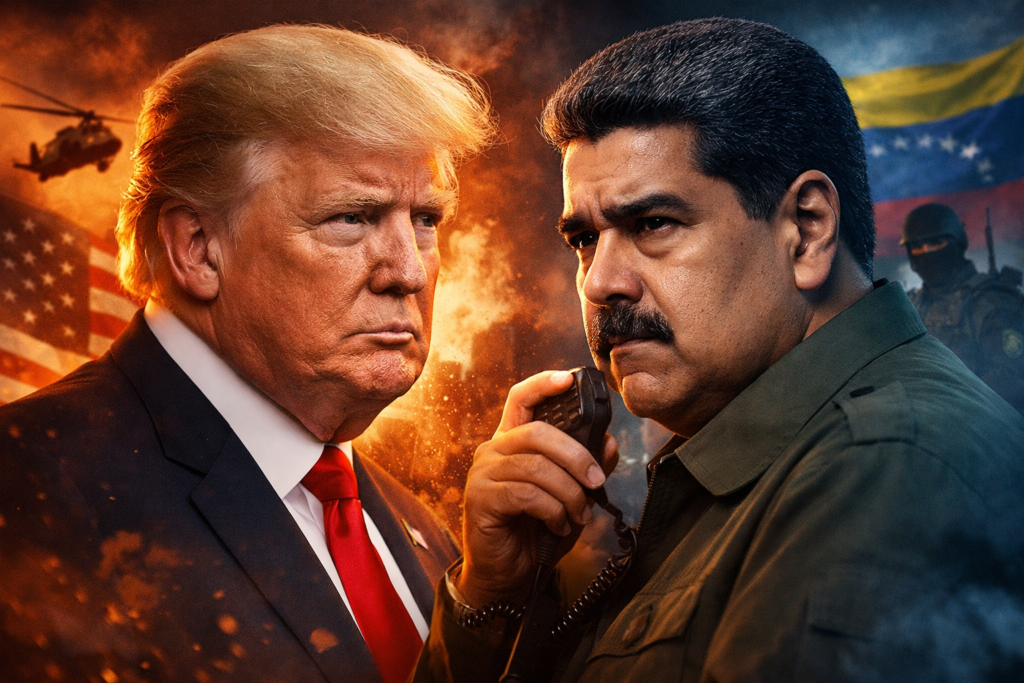

From time to time, rumors surface about extraordinary plans to remove Venezuelan President Nicolás Maduro from power through direct action. Among the most striking of these is the notion that he could have been seized from his private residence—perhaps even from his bedroom—in a swift, decisive operation. Such accounts are often presented as daring and narrowly focused, implying a quick intervention that could alter the country’s political trajectory overnight. Yet when examined closely, the idea reveals far more about the complexity and danger of modern power struggles than about any realistic path to change.
The capture of a sitting head of state is among the most sensitive and perilous undertakings imaginable. In Maduro’s case, the risks would not have been limited to the immediate operation itself. They would have extended into Venezuela’s internal stability, regional security, and the broader geopolitical landscape, potentially triggering consequences far beyond what proponents might have anticipated.
A Presidency Built Around Permanent Threat
To understand why such an operation would be extraordinarily risky, it is necessary to understand the environment in which Maduro governs. Venezuela has endured more than a decade of political polarization, economic crisis, and international pressure. During this period, the government has repeatedly claimed to face coup attempts, assassination plots, and foreign-backed destabilization efforts. Whether all such claims are credible is a matter of debate, but their cumulative effect on state behavior is undeniable.
The presidency has become the center of an extensive security architecture. Maduro’s personal protection reportedly involves elite military units, intelligence agencies, and counterintelligence specialists whose primary mission is regime preservation. Security is structured not simply to repel attacks, but to prevent information leaks, insider threats, and coordinated actions across different branches of the state.
Unlike leaders whose routines are publicly visible, Maduro’s movements are deliberately opaque. He is known to rotate between secure locations, vary travel patterns, and limit advance knowledge of his whereabouts. This unpredictability is not incidental; it is a core element of his protection strategy. Any attempt to reach him in a private setting would require real-time intelligence of exceptional accuracy, combined with access to secure spaces that are continuously monitored.
The Illusion of Simplicity
The idea of a “bedroom snatch” draws its appeal from simplicity. It suggests that political power resides entirely in one individual and that removing that individual will cause the system to collapse. In practice, modern states—particularly those under pressure—do not function this way.
Maduro’s authority is embedded in a network of institutions, loyalties, and enforcement mechanisms. The armed forces play a central role, as do intelligence services and ruling-party structures that have been carefully cultivated over years. These institutions do not vanish with the removal of a single figure. On the contrary, they are often designed to survive leadership shocks and respond aggressively to perceived threats.
Security professionals note that even in countries with weaker institutions, leadership capture operations are fraught with uncertainty. In a state like Venezuela, where regime survival has been prioritized above nearly all else, the margin for error would be minimal. A single miscalculation—an unexpected guard rotation, a compromised insider, or a delay of minutes—could expose an operation and lead to immediate and violent failure.
Lessons From Past Failures
Venezuela’s recent history offers sobering examples of what happens when such realities are underestimated. The failed maritime incursion in 2020, commonly referred to as Operation Gideon, involved a small group of armed individuals attempting to spark a broader uprising. The operation collapsed almost as soon as it began. Participants were quickly captured or killed, and the Venezuelan government used the episode to reinforce its narrative of foreign aggression.
More importantly, the aftermath reshaped the security environment. The government conducted internal reviews, purged suspected disloyal elements, and expanded surveillance within the military and intelligence services. Far from weakening the regime, the incident strengthened its defensive posture and justified further concentration of power.
These events underscore a pattern seen elsewhere: failed attempts at rapid regime change often make subsequent efforts more difficult. Each exposed vulnerability is patched, each internal weakness scrutinized. By the time new plans are conceived, the environment is typically more hostile than before.
The International Stakes
Any serious attempt to seize Maduro would also carry significant international implications. Venezuela is not diplomatically isolated in the way some portray it. It maintains strategic relationships with several major powers that view the survival of the current government as aligned with their interests.
These relationships involve more than political statements. They include economic investments, energy cooperation, arms sales, and intelligence coordination. As a result, an operation targeting the president would not be viewed solely as a domestic Venezuelan matter. It would raise immediate questions about external involvement, sponsorship, or tacit approval.
In such circumstances, even ambiguity can be dangerous. Governments affected by the outcome might feel compelled to respond, whether through diplomatic pressure, economic measures, or indirect actions elsewhere. At a time when global politics is already marked by proxy conflicts and strategic competition, the repercussions could extend well beyond Latin America.
What Happens After Success?
Even if one assumes, for the sake of argument, that a leadership capture operation succeeded, the aftermath would pose challenges as serious as the operation itself. Removing Maduro by force would not automatically produce consensus around a successor or a new political framework.
Venezuela’s armed forces are not a monolithic entity. They consist of different factions, interests, and loyalties, many of which are closely tied to the existing system. A sudden removal of the president could create uncertainty at the top of the command structure, prompting rival claims to authority. In such situations, fragmentation is a real risk.
Civil unrest would also be likely. Supporters of the government, opposition groups, and non-aligned citizens could all respond differently, creating a volatile mix of protest, counter-protest, and potential violence. Without a clear and broadly accepted transition plan, the result could be prolonged instability rather than resolution.
History provides numerous examples of states where the removal of a leader did not bring peace or reform, but instead opened the door to deeper conflict. Venezuela’s economic fragility and social divisions would make it especially vulnerable to such an outcome.
Why Such Ideas Persist
The persistence of stories about dramatic interventions reflects a broader frustration with Venezuela’s prolonged crisis. For those who view the situation as intolerable, the appeal of a swift, decisive action is understandable. It offers the promise of clarity in a landscape marked by stalemate.
Yet this appeal often rests on an oversimplified understanding of power. Political systems, particularly under stress, are resilient in ways that outsiders frequently underestimate. They adapt, harden, and close ranks when threatened.
For intelligence and military professionals, this reality informs a general reluctance to pursue leadership capture operations except in the context of open war. Even then, such missions are approached cautiously, with extensive planning and acceptance of high risk. Outside of wartime conditions, the political costs often outweigh any perceived benefits.
A Narrative Versus Reality
The notion of seizing a president from his bedroom is compelling because it humanizes power, reducing it to a single vulnerable moment. In reality, power in Venezuela is institutional, distributed, and enforced through systems designed to endure.
The real significance of these rumors lies not in whether such an operation was imminent, but in what they reveal about the limits of force as a solution to complex political crises. They highlight the gap between dramatic narratives and operational reality, between public imagination and the constraints faced by those who operate in the shadows.
Ultimately, Venezuela’s future is unlikely to be determined by a single dramatic act. Sustainable change, if it comes, will depend on negotiations, institutional shifts, and broader social and economic reconstruction. Attempts to shortcut that process through force risk compounding the very problems they seek to solve.
In that sense, the idea of a “bedroom snatch” serves as a cautionary tale. What may appear bold and decisive on the surface can, upon closer inspection, reveal itself to be one of the most dangerous and destabilizing options available—far riskier than it ever seemed.