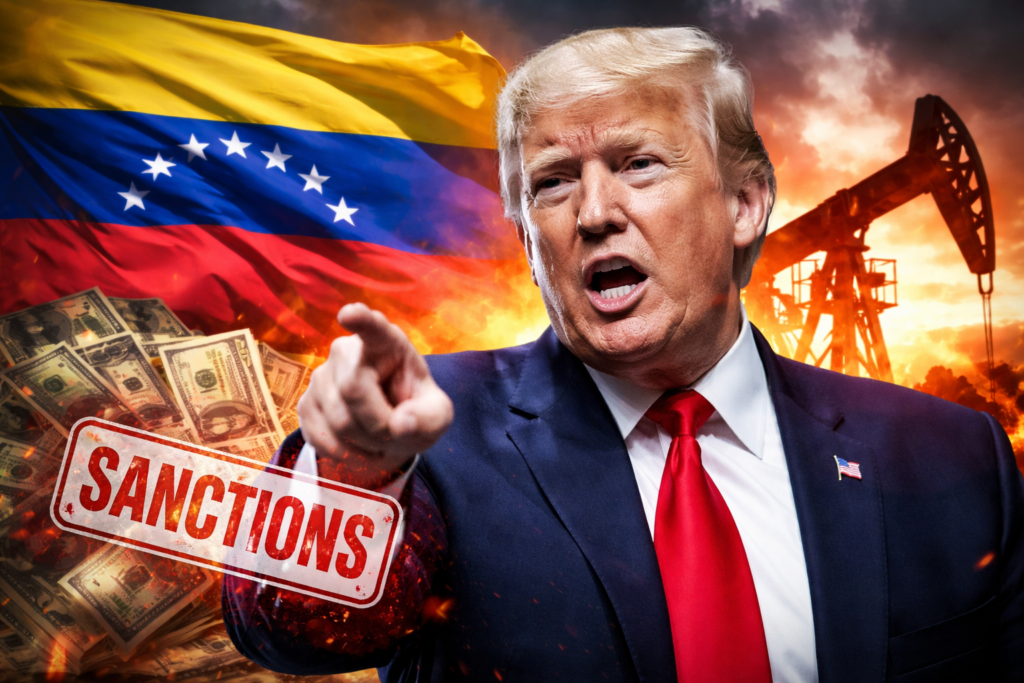

Former US President Donald Trump has once again brought Venezuela into the spotlight of American foreign policy discussions, signaling that a return to the White House would likely mean a dramatic shift in Washington’s approach toward the South American nation. During recent campaign appearances and interviews, Trump criticized the current US administration for relaxing sanctions on Caracas, arguing that such policies have weakened American leverage while empowering Venezuela’s long-standing leadership.
Venezuela, home to the world’s largest proven oil reserves, has long been a central point of tension between Washington and Caracas. Trump’s renewed focus on the country reflects not only geopolitical concerns but also broader themes that define his foreign policy narrative: economic pressure, national sovereignty, energy independence, and a hardline stance against governments he views as hostile to US interests.
Trump’s Previous Venezuela Strategy
During his presidency from 2017 to 2021, Donald Trump adopted what his administration described as a “maximum pressure” strategy against Venezuela. This approach relied heavily on economic sanctions targeting Venezuela’s oil sector, government officials, state-owned enterprises, and access to international financial systems. The goal, according to Trump administration officials at the time, was to force political change by cutting off revenue streams that sustained the government.
Under this policy, US sanctions significantly limited Venezuela’s ability to export oil to global markets, particularly to American refiners that had historically relied on Venezuelan crude. The sanctions also restricted transactions with Venezuela’s state oil company, PDVSA, contributing to a sharp decline in national oil output and government income.
Trump and his allies frequently pointed to these measures as evidence of a firm and effective foreign policy stance. In recent remarks, Trump reiterated his belief that sanctions were working before being scaled back, stating that economic pressure had pushed Venezuela closer to negotiations and international scrutiny.
Criticism of Current US Policy
Trump has repeatedly criticized the Biden administration for easing some restrictions on Venezuela, especially those related to oil production and exports. He argues that allowing limited oil trade has provided financial relief to Venezuela’s leadership without achieving meaningful political reform.
According to Trump, the relaxation of sanctions undermines US negotiating power and sends a message that pressure tactics can be reversed without substantial concessions. He has framed the issue as part of a broader critique of what he calls “weak” foreign policy decisions that prioritize short-term economic considerations over long-term strategic goals.
Supporters of the current policy argue that selective easing of sanctions is intended to encourage dialogue, improve humanitarian conditions, and stabilize energy markets amid global supply disruptions. However, Trump’s stance suggests a sharp departure from this approach, favoring immediate and decisive economic pressure instead.
Venezuela’s Oil and Global Energy Markets
Oil lies at the heart of the US-Venezuela relationship, and Trump’s statements reflect the strategic importance of energy in global politics. Venezuela’s vast reserves once made it a major supplier to the United States, but years of mismanagement, sanctions, and infrastructure decay have severely reduced production.
Trump has linked Venezuela’s oil exports to broader discussions about American energy independence. He has argued that the US should prioritize domestic production rather than relying on foreign energy sources, particularly from governments that Washington views as adversarial.
Any move to reinstate tougher oil sanctions could have wide-ranging effects on global energy markets. Analysts note that even limited Venezuelan oil exports can influence supply dynamics, especially during periods of volatility. A return to strict sanctions could tighten supply and raise concerns among energy-importing nations.
Political Messaging and the 2026 Election Cycle
Trump’s renewed focus on Venezuela also carries clear political implications as the US moves deeper into the 2026 election cycle. Foreign policy issues often serve as symbolic markers in presidential campaigns, allowing candidates to demonstrate leadership, strength, and clarity of vision.
By emphasizing Venezuela, Trump is reinforcing a broader campaign narrative centered on restoring what he describes as American strength on the world stage. His comments resonate with supporters who favor assertive diplomacy and view sanctions as a legitimate tool of statecraft.
Venezuela also serves as a contrasting example in Trump’s messaging, allowing him to differentiate his policies from those of the current administration. The issue intersects with domestic concerns such as energy prices, border security, and economic stability, making it particularly effective as a campaign talking point.
Reaction from Venezuela and the International Community
Venezuelan officials have consistently condemned US sanctions, arguing that they contribute to economic hardship for ordinary citizens rather than political change. In response to Trump’s recent remarks, representatives from Caracas reiterated calls for the complete removal of sanctions and accused Washington of using economic pressure as a political weapon.
International reactions to potential policy changes remain mixed. Some regional governments support diplomatic engagement and gradual easing of restrictions, while others align more closely with Washington’s concerns about governance and democratic standards in Venezuela.
Global powers monitoring the situation recognize that US policy shifts can reshape diplomatic alignments across Latin America. A renewed sanctions regime under a future Trump administration could alter trade relationships, regional cooperation, and geopolitical dynamics beyond Venezuela itself.
Humanitarian Considerations and Economic Impact
One of the most debated aspects of sanctions policy involves their humanitarian consequences. Critics argue that economic restrictions worsen living conditions by limiting access to essential goods, healthcare resources, and financial stability. Supporters counter that sanctions target government revenue rather than humanitarian aid and that responsibility lies with national leadership.
Trump has acknowledged humanitarian concerns in the past but maintains that economic pressure is necessary to achieve political outcomes. He has argued that easing sanctions without systemic reforms risks prolonging economic instability rather than resolving it.
Experts remain divided on the effectiveness of sanctions as a tool for political change. While some point to historical cases where economic pressure influenced negotiations, others highlight examples where sanctions entrenched existing power structures.
US-Latin America Relations Under a Potential Trump Return
Venezuela is just one component of a broader US-Latin America policy framework that could be reshaped under a Trump return. His previous administration favored bilateral negotiations, economic leverage, and reduced emphasis on multilateral institutions.
A tougher stance on Venezuela could signal similar approaches toward other regional issues, reinforcing a policy direction focused on national interest and strategic competition. Analysts note that this approach could reshape diplomatic priorities and economic partnerships across the hemisphere.
For US allies in the region, clarity in Washington’s policy direction is crucial. Trump’s recent statements suggest predictability in terms of firmness, even if the broader implications remain uncertain.
Strategic Implications for the United States
From a strategic standpoint, Venezuela represents more than an isolated foreign policy challenge. Its energy resources, regional influence, and international partnerships place it at the intersection of global economic and political interests.
Trump’s emphasis on sanctions reflects a belief that economic tools can achieve strategic goals without direct military involvement. This approach aligns with his broader foreign policy philosophy, which prioritizes economic strength as a foundation of national power.
Whether this strategy would produce different outcomes in a second term remains a subject of debate among policymakers and analysts. What is clear is that Venezuela would once again become a focal point of US foreign policy decision-making.
Looking Ahead
As political momentum builds and campaign rhetoric intensifies, Donald Trump’s comments on Venezuela provide insight into how a future administration might approach the issue. His emphasis on sanctions, oil policy, and economic pressure suggests a return to familiar strategies rather than a new diplomatic experiment.
For Venezuela, the prospect of renewed US pressure introduces uncertainty at a time when the country faces ongoing economic and social challenges. For global markets and regional partners, the implications extend beyond bilateral relations.
Ultimately, the direction of US-Venezuela relations will depend on political outcomes in Washington and evolving conditions on the ground. What remains certain is that Venezuela has once again emerged as a defining issue in America’s foreign policy debate, with Donald Trump positioning it as a key test of leadership, strategy, and national interest.