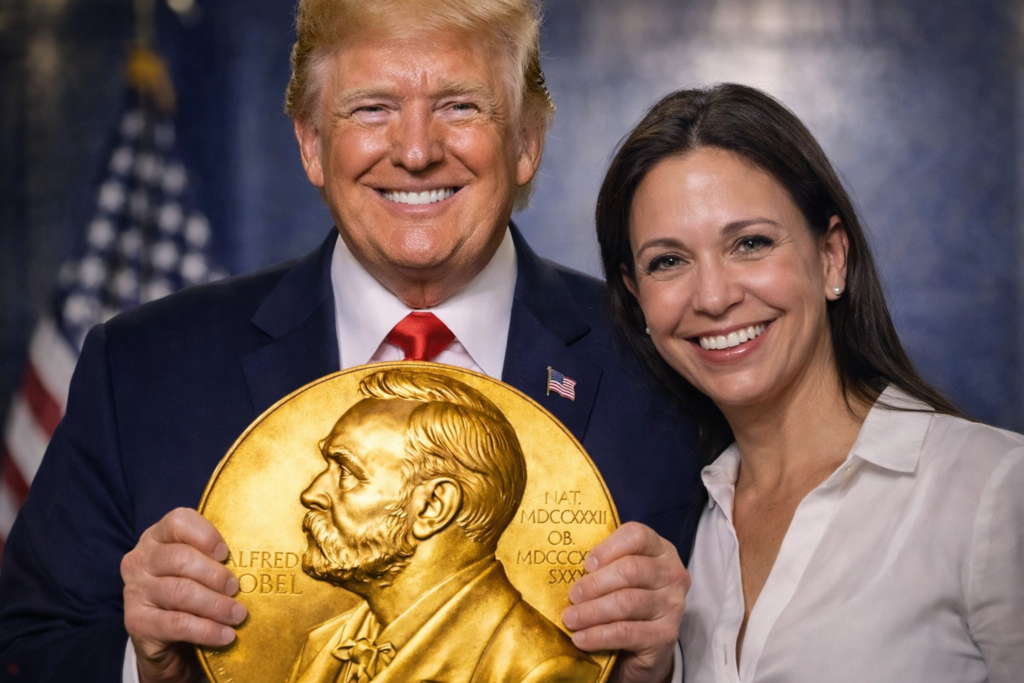

For a brief moment, social media seemed convinced that Donald Trump had finally achieved something his supporters have talked about for years: a Nobel Peace Prize. Posts spread rapidly, some celebratory, some sarcastic, all centered around the same striking claim. Venezuelan opposition leader María Corina Machado had “presented” her Nobel Peace Prize medal to Trump.
The images were real. The moment happened. But the meaning behind it was far more complex than the headlines suggested.
What followed was a mix of confusion, excitement, outrage, and debate, all driven by a symbolic gesture that blurred the line between political gratitude and official recognition. To understand why this moment resonated so strongly, it is helpful to consider who María Corina Machado is, what the Nobel Prize represents, Trump’s long history with the award, and how modern politics turns symbols into viral events.
Who Is María Corina Machado?
María Corina Machado is one of the most prominent opposition figures in Venezuela. For years, she has been a vocal critic of President Nicolás Maduro and the political system that has kept him in power. She has built her reputation around calls for democratic reform, international pressure, and resistance to what she describes as authoritarian rule.
Machado’s political journey has not been smooth. She has faced bans, threats, and legal challenges inside Venezuela. Despite this, she has remained a central figure in opposition politics, gaining international recognition for her activism and persistence.
In recent years, Machado has received international honors and recognition tied to her advocacy for democracy and human rights. Among these was a Nobel Peace Prize–related medal linked to broader opposition recognition. While the details of the award structure are often misunderstood online, the key point is that the medal she holds represents international acknowledgment of democratic struggle, not a personal ability to grant Nobel Prizes to others.
The Moment That Sparked the Frenzy
At a public political event, Machado appeared alongside Donald Trump. During the appearance, she handed him a Nobel Peace Prize medal in a gesture that was clearly meant to be symbolic. Cameras captured the moment. Trump accepted the medal. Machado spoke about leadership, pressure on authoritarian regimes, and the importance of standing up to governments like Maduro’s.
Within minutes, photos and short video clips began circulating online. Many posts stripped the moment of its explanation and turned it into a simple claim: Trump had been given a Nobel Peace Prize.
The truth, however, is more nuanced.
Machado did not award Trump a Nobel Prize. She does not sit on the Nobel Committee. She did not announce a decision by any official body. The Nobel Peace Prize can only be awarded by the Norwegian Nobel Committee, following a formal nomination and selection process. No such announcement has been made.
What Machado offered was a symbolic presentation. Symbolism, in modern politics, can be a powerful force.
Why Machado Chose Trump
To understand why Machado made this gesture, you have to look back at Trump’s presidency and his approach to Venezuela. Under Trump, the United States took a hardline stance against Maduro’s government. Sanctions were expanded. Diplomatic pressure increased. The U.S. openly supported Venezuelan opposition figures and recognized alternative leadership claims.
For Machado and many in the Venezuelan opposition, those actions mattered deeply. They believe the pressure weakened Maduro’s international standing and gave legitimacy to democratic resistance inside Venezuela.
By presenting the medal, Machado was expressing gratitude. She was also making a political statement, aligning herself with Trump’s record on Venezuela and signaling that she views his actions as worthy of recognition.
Supporters see this as a sincere acknowledgment. Critics see it as political theater. Either way, the gesture was intentional and carefully staged.
Trump and the Nobel Peace Prize Debate
Donald Trump and the Nobel Peace Prize have been linked in conversation for years. During his presidency, Trump repeatedly pointed out that other leaders received the award for diplomatic efforts he believed were comparable to his own.
His supporters argue that his role in Middle East agreements, diplomatic outreach to North Korea, and pressure-based foreign policy deserved Nobel consideration. They often contrast this with former President Barack Obama, who received the Nobel Peace Prize early in his presidency, a decision that remains controversial among conservatives.
Trump himself has openly said he believes he deserved the prize. His critics strongly disagree, citing his rhetoric, domestic policies, and approach to international relations.
This long-running debate made Machado’s gesture especially combustible. It tapped into an existing narrative and reignited it instantly.
How the Internet Turned Symbolism Into “Breaking News”
In today’s media environment, context often loses the race to virality. A single image can travel faster than a full explanation. That is exactly what happened here.
Many posts did not lie outright, but they omitted critical details. Words like “presented,” “handed,” or “gave” were interpreted by readers as “awarded.” Memes exaggerated the moment. Some accounts framed it as long-overdue justice. Others mocked it as absurd.
The result was a split reaction. Trump supporters celebrated. Critics accused the story of being misleading propaganda. Fact-checkers rushed to clarify what actually happened.
This pattern is increasingly common. Symbolic gestures are designed to be visual and emotional. Social media rewards simplicity and shock. Nuance often arrives later, if at all.
What the Nobel Peace Prize Actually Is
The Nobel Peace Prize is one of the world’s most recognized awards, but it is also one of the most misunderstood. It is not a lifetime achievement award. It is not voted on by the public. It is not decided by political leaders.
Each year, eligible nominators submit names. A committee reviews those nominations and selects a winner. The process is confidential. Decisions are announced officially by the Norwegian Nobel Committee.
No one can “give” someone else a Nobel Prize. Medals associated with the prize may be displayed, shared symbolically, or used to honor causes, but they do not transfer the award itself.
This distinction is important, especially when viral stories blur the line between symbolism and official recognition.
Why This Moment Still Matters
Even though Trump did not receive a Nobel Peace Prize, the moment still matters politically. Machado’s gesture was a public endorsement. It was also a signal to her supporters and to international audiences about where she stands.
For Trump, the moment reinforced an image his supporters already believe in: that his foreign policy efforts are underappreciated by global elites. For critics, it reinforced concerns about political theater and misinformation.
For the broader public, the incident became a lesson in how quickly narratives form online.
Venezuela, U.S. Politics, and Global Messaging
This episode also highlights how domestic U.S. politics and international struggles intersect. Machado’s fight against Maduro is not just a Venezuelan issue. It involves global alliances, sanctions, and diplomatic pressure.
By aligning herself with Trump, Machado was also making a statement about which type of international leadership she believes is effective. That message resonates differently depending on political perspective.
Some see it as courage. Others see it as opportunism. Both interpretations exist, and both fuel debate.
Media Responsibility and Public Skepticism
One of the most striking aspects of this story is how easily it could mislead casual readers. Headlines designed to attract clicks can sacrifice clarity. Social media posts often lack context by design.
This puts more responsibility on readers to pause, read carefully, and question what they see. It also challenges journalists and content creators to balance engagement with accuracy.
The phrase “Trump finally gets a Nobel” works because it triggers emotion. But emotion without explanation leads to confusion.
Trump’s Reaction and Political Impact
Trump appeared pleased by the gesture, though he did not claim it was an official Nobel award. His acceptance fit neatly into his long-standing narrative about being unfairly treated by institutions and media.
For his supporters, the moment reinforced loyalty. For his opponents, it confirmed their belief that symbolism is being used to manipulate perception.
Politically, the impact is more cultural than formal. No policy changed. No award was granted. But the conversation shifted, even briefly.
The Power of Symbols in Modern Politics
Politics today runs on images as much as ideas. A handshake, a medal, a moment on stage can travel further than a policy paper ever will.
Machado understood this. Trump understands it too. The moment was designed to be seen, shared, and discussed.
In that sense, it succeeded completely.
Separating Fact From Feeling
At the center of this story is a tension between fact and feeling. Factually, Trump did not receive a Nobel Peace Prize. Emotionally, many people felt as though something significant had happened.
That gap between reality and perception is where modern political drama lives.
Understanding that gap does not require cynicism. It requires curiosity and attention.
The Bottom Line
Donald Trump has not won a Nobel Peace Prize. No official body has announced such a decision. María Corina Machado did not grant him one.
What she did was symbolic. She offered a medal as a gesture of gratitude and political alignment, highlighting what she views as Trump’s role in challenging authoritarian rule in Venezuela.
The internet turned that symbolism into a headline. The headline turned into belief. And belief turned into debate.
In the end, the story says less about the Nobel Prize and more about how politics, perception, and social media now work together. Symbols move faster than facts. Context arrives later. And moments like this remind us why slowing down still matters.