
Former US President Donald Trump has once again placed immigration at the forefront of national political debate, signaling that border security and enforcement would be central pillars of his agenda should he return to the White House. Through a series of recent campaign speeches, interviews, and public statements, Trump has outlined a vision of immigration policy that closely mirrors — and in some areas expands upon — the approach he pursued during his first term.
Immigration has long been one of the most polarizing issues in American politics, and Trump’s renewed emphasis underscores its enduring significance. By framing the issue as one of national security, economic stability, and rule of law, Trump is reviving themes that galvanized his political base while also reigniting a broader national conversation about how the United States manages its borders.
Immigration as a Core Political Message
From the earliest days of his political career, Trump has positioned immigration as a defining issue. His initial presidential campaign was marked by calls for stronger border enforcement and a fundamental rethinking of asylum and migration policies. Today, as political momentum builds toward the next election cycle, Trump’s rhetoric suggests a return to that same strategy.
In recent remarks, Trump has accused the current administration of weakening border controls and abandoning enforcement mechanisms that he claims were effective during his presidency. He has argued that policy reversals have encouraged higher levels of migration, placing strain on federal agencies and local governments.
Supporters view this message as a call for accountability and order, while critics see it as a continuation of divisive rhetoric. Regardless of perspective, immigration remains a powerful political tool — one that Trump appears determined to leverage once again.
The Border as a Symbol and Policy Priority
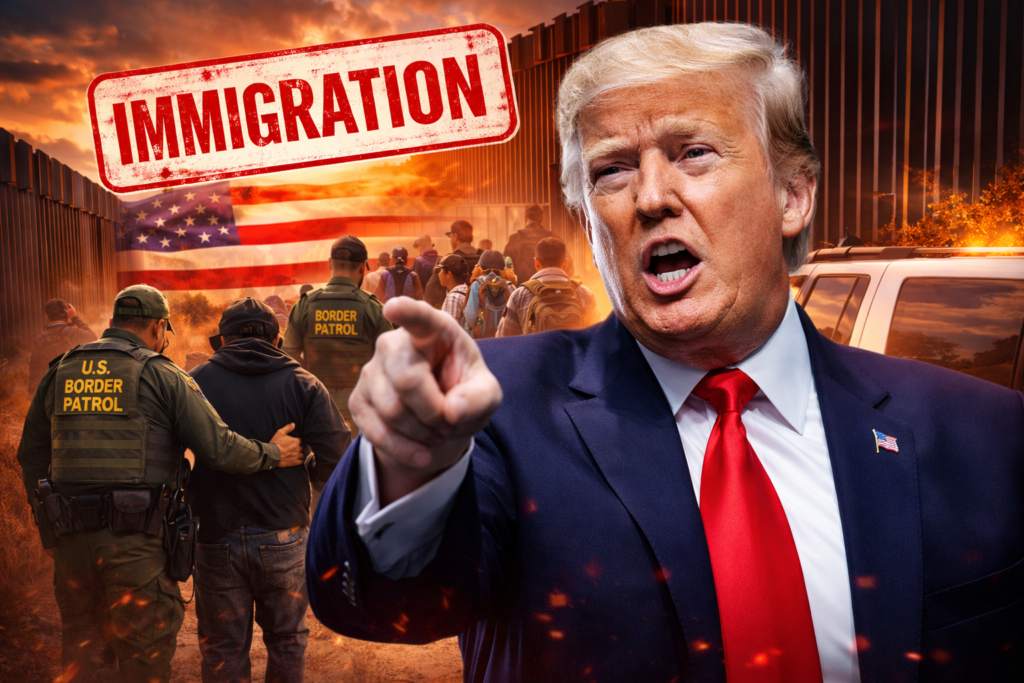
At the center of Trump’s immigration message is the US southern border. He has repeatedly described the border as a frontline issue, arguing that lax enforcement undermines national sovereignty and public safety. During campaign appearances, Trump has emphasized physical barriers, surveillance technology, and increased personnel as essential components of border security.
The border wall, one of the most recognizable symbols of Trump’s first term, has returned to prominence in his speeches. Trump has suggested that a renewed administration would prioritize completing and expanding border infrastructure, framing it as both a practical deterrent and a symbolic reaffirmation of national boundaries.
While experts debate the effectiveness of physical barriers alone, Trump’s emphasis reflects a broader enforcement-first philosophy — one that prioritizes visible control measures alongside administrative changes.
Enforcement and Policy Reversals
Trump has signaled that a future administration would move swiftly to reverse immigration policies implemented under the current leadership. These potential changes include stricter asylum standards, expanded use of expedited removals, and enhanced cooperation between federal and local law enforcement agencies.
During his first term, Trump relied heavily on executive authority to enact immigration measures, often bypassing congressional gridlock. His recent comments suggest a similar approach, with a focus on immediate action rather than prolonged legislative negotiations.
Critics argue that reliance on executive actions creates instability and legal challenges, while supporters contend that decisive leadership is necessary in the absence of congressional consensus. This tension highlights the broader difficulty of achieving lasting immigration reform in a deeply divided political environment.
Economic Arguments and Labor Market Concerns
Beyond border security, Trump has framed immigration as an economic issue, arguing that uncontrolled migration affects wages, employment opportunities, and public resources. He has claimed that stricter enforcement would protect American workers and reduce pressure on social services.
Economists, however, remain divided on the economic impact of immigration. Some studies suggest that immigration contributes positively to economic growth, innovation, and labor market flexibility. Others highlight localized challenges, particularly in communities experiencing rapid population changes.
Trump’s messaging focuses on the latter, emphasizing the need to prioritize citizens and legal residents in economic planning. This narrative resonates with voters who feel economically marginalized, even as it sparks debate among policy experts.
National Security and Public Safety Claims
National security has been another central theme in Trump’s immigration rhetoric. He has argued that inadequate border controls increase the risk of criminal activity and undermine law enforcement efforts. While crime statistics related to immigration remain contested, Trump’s framing positions border security as an essential component of public safety.
Supporters argue that strong enforcement enhances security by ensuring accountability and reducing illegal activity. Critics counter that linking immigration broadly to crime oversimplifies complex issues and risks stigmatizing entire communities.
The security argument, however, remains politically potent, particularly during periods of heightened concern about border crossings and resource allocation.
Humanitarian Dimensions and Asylum Policy
Immigration policy also carries significant humanitarian implications, particularly regarding asylum seekers and displaced populations. Trump’s previous administration implemented stricter asylum rules, citing concerns about abuse of the system and lengthy backlogs.
In recent statements, Trump has suggested a return to more restrictive asylum standards, emphasizing rapid processing and deterrence. Human rights advocates argue that such measures risk limiting access to protection for vulnerable individuals fleeing violence or persecution.
Balancing humanitarian obligations with enforcement priorities remains one of the most complex aspects of immigration policy. Trump’s approach prioritizes deterrence, while critics call for expanded legal pathways and international cooperation.
Congressional Gridlock and Legislative Challenges
Despite decades of debate, comprehensive immigration reform has remained elusive in Congress. Partisan divisions, competing priorities, and regional differences have repeatedly stalled legislative efforts.
Trump has used this gridlock to justify executive action, arguing that decisive leadership is necessary when lawmakers fail to act. His critics, however, contend that sustainable solutions require bipartisan legislation rather than unilateral measures.
The ongoing stalemate underscores the difficulty of reconciling diverse perspectives on immigration, from border security advocates to reform-oriented policymakers.
Impact on US-Mexico Relations
Immigration policy inevitably affects US-Mexico relations, as the southern border serves as a shared responsibility. During his first term, Trump’s policies reshaped diplomatic dynamics, emphasizing enforcement and bilateral agreements.
A renewed focus on strict border measures could once again influence cooperation on trade, security, and migration management. Analysts note that effective border policy often requires coordination beyond domestic measures, including regional partnerships and economic development initiatives.
Immigration and the 2026 Election Landscape
As the election cycle progresses, immigration is expected to remain a central campaign issue. Trump’s emphasis reflects a broader strategy of drawing clear contrasts with current policies and mobilizing supporters around familiar themes.
Public opinion on immigration remains deeply divided, with shifts often influenced by economic conditions, media coverage, and policy outcomes. Trump’s messaging seeks to capitalize on these dynamics, framing immigration as a decisive test of leadership and governance.
Broader Implications for American Society
Beyond policy debates, immigration touches fundamental questions about national identity, values, and the rule of law. Trump’s rhetoric emphasizes order, control, and enforcement, reflecting a vision of governance centered on boundaries and authority.
Critics advocate for a more inclusive approach, highlighting America’s history as a nation shaped by immigration. The tension between these perspectives continues to define the national conversation.
Looking Ahead
As Donald Trump continues to articulate his immigration vision, the issue is once again positioned as a defining element of US political discourse. Whether his proposals gain traction will depend on electoral outcomes, legislative dynamics, and public response.
What remains clear is that immigration will continue to shape debates about security, economy, and identity. Trump’s renewed focus ensures that the topic will remain at the center of national attention in the months ahead, influencing policy discussions and political strategies across the country.